
speaking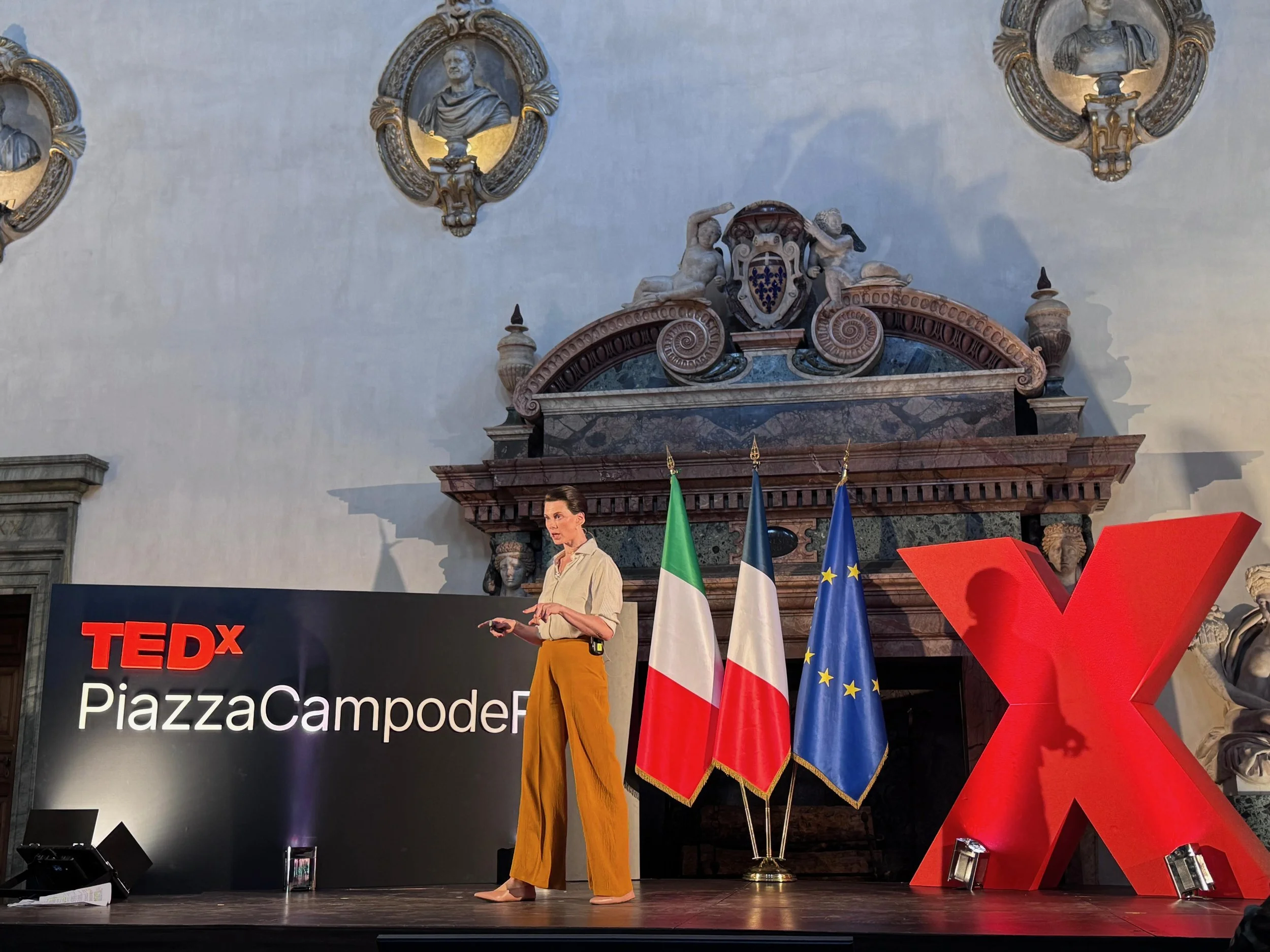
I speak at the intersection of food systems, ecological stewardship, and human wellbeing — drawing on academic training in biomedicine and food policy at the London School of Economics, almost a decade co-founding and running a regenerative farm on Long Island, and a meditation practice rooted in more than a decade of daily experience, which I've been teaching formally since 2023.
My talks are research-grounded and experiential — built from what I've actually done, not what I've read about. I speak to audiences of all ages: from elementary school students to an invited audience at the French Embassy in Rome alongside a Nobel laureate, the World Food Program's Nutrition Director, and the President of Italy's Superior Health Council. The through-line is the same: I make complex ideas feel immediate and personal, so people can find their own entry point — and actually do something with what they've heard.
What connects these topics isn't a curriculum — it's a worldview. Food systems, fiber, living systems, and the inner technologies of change are all expressions of the same question: how the systems that sustain us become invisible to us — and the cost of that invisibility in ecological loss, policy failure, and the unconscious patterns that keep us making the same mistakes that harm ourselves and others. My talks are compelling because I have lived these connections daily, not just studied them — and because I have found, consistently, that when people see them clearly, something shifts. Wonder is not a soft outcome. It is the beginning of changed behavior. I invite audiences to think in the same systems terms, rediscovering the thread that runs from their plate to their community to their own mind.
Talks-
Every moment, your mind is assembling reality from an infinite stream of data — and what you experience is its construction, not reality itself. Have you ever examined the instrument doing the assembling?
We spend enormous energy building better systems, better organizations, better policies. We rarely examine the instrument doing the generating: the mind itself. An unexamined mind, however brilliant and however well-intentioned, will trip itself up by repeating unconscious patterns. This is not a character flaw. It is how the mind works. The result: we work toward progress while quietly blocking it.
This talk doesn't just make the argument. It puts it to the test. A guided meditation at the close gives participants a direct experience of catching their own mind in the act — something a video can't replicate and that sticks precisely because they felt it themselves.
Suitable for: leadership conferences, university programs, healthcare and wellness organizations, corporate retreats, policy and advocacy audiences. Available as keynote (20–30 min) with guided meditation component. The TEDx version is available to watch online — the live experience is something different.
-
In a world where AI is changing every industry, some of the most future-proof careers are rooted in the oldest work there is.
This talk introduces young audiences to the living world right outside their door — and to a career path that no algorithm can replace. Farming today isn't just growing food. It's science, design, storytelling, community building, animal care, and entrepreneurship, all in one. Creative, outdoorsy kids who love nature, animals, and people are exactly who small farms need — and exactly who can help grow them into vibrant community centers with real environmental impact.
Through real animals, real plants, and real stories from Mama Farm — our regenerative farm on Long Island — students discover what regenerative farming means, why seeds and animals can become endangered, and why biodiversity matters for the food we eat, the air we breathe, and the water we drink. They also discover what a modern farm can be: a place for concerts and farm dinners, craft workshops in basketry and natural dyeing, floral design, painting, fiber arts, and community celebrations — all rooted in the season and land. And they leave understanding that showing up for the living world around them is not just meaningful work. It’s work that will always need a human being to do it.
Audiences leave curious, connected to their local environment, and with concrete actions they can take right now — in their backyard, their school garden, and their community.
Suitable for: elementary, middle and high school classrooms, school assemblies, career days, environmental education programs, and BOCES partnerships. Available as a classroom visit, assembly format, or farm field trip. Can include a guided breathing and mindfulness component for younger audiences.
-
The clothes on your back and the food on your plate are portals. Most of us have stopped looking through them.
We interact with food and fabric every single day — and almost never stop to ask where they came from, whose hands made them, what land they grew from, or what knowledge was required to produce them. This talk traces that invisible web: from my foraging experiment gone wrong and a revelation in the ancient textile galleries of the Met, to a graduate education in food systems at the London School of Economics, to co-founding a regenerative farm on Long Island that raises heritage breed animals, grows heirloom seeds, and runs a working wool lab.
Food and fiber are not commodities. They are living systems — and the knowledge, craft, and biodiversity that sustain them cannot be rebuilt once they are lost. When we choose to see that web, and to support the farmers, artisans, and makers who keep it alive and vibrant, we become part of it. And the web holds.
Audiences leave with a new way of seeing the objects and systems closest to them — and a clear understanding of where their choices, their commissions, and their curiosity can have the most impact.
Suitable for: sustainability and design conferences, fashion and textile programs, environmental humanities, craft organizations, corporate ESG audiences, universities. Available as keynote (20–45 min) with Q&A.
-
Small diversified farms are sophisticated operations — petri dishes for entrepreneurship, resilience, and community cohesion. And yet the systems that could be supporting them are largely blind to them, or actively working against them.
New York State alone has more than 30,000 farms — and the number is falling. Nearly 3,000 were lost in the last five years. This is not a local story. The stakes extend far beyond any single region: food security, biodiversity, climate and community resilience, and the connection of people — including and especially children — to the source of their food and fiber. Their loss is not only ecological — it is spatial and civic: the disappearance of the mixed, diversified communities that farms anchor, the blend of agricultural, commercial, and residential life that makes a place genuinely pleasurable and enriching to live in, rather than another landscape of suburbs and strip malls. Farms are where abstract concepts become tangible: how soil health affects nutrition, how pollinators create food, how seasons govern life, the importance of clean water for crops, how climate change is not a distant threat but something you can actually see — or not — in your pantry or on your table. When farms disappear, so does that understanding.
This talk makes the case for agritourism as a policy framework — drawing on the European model, the real economics of small farm life, and the regulatory barriers that currently prevent farmers from innovating. It also makes the case that these farms are not just local assets. They are blueprints — for food security, climate resilience, and community cohesion — that belong in the conversations happening at the highest levels of agricultural and environmental policy.
Audiences leave with a clear understanding of what agritourism actually is, what it makes possible, what stands in the way, and what legislators, educators, and community leaders can do about it.
Suitable for: universities, policy forums, government and legislative audiences, agricultural conferences, environmental organizations, civic and community leadership programs. Available as keynote or workshop (20–60 min with Q&A).
-
Mama Farm is a five-acre regenerative farm on Long Island. We raise heritage breed animals, grow heirloom seeds, run a wool lab, host a B&B, and offer programming to our community. We are also, on paper, almost invisible — we don't fit the frameworks built to support agriculture. Too small for one category, too diversified for another, too multifaceted for any single funding structure to see us whole.
We are not alone. Across New York State, nearly 3,000 farms disappeared in the last five years. Most of them weren't failing. They were just too easy to overlook — dismissed as hobby farms by people who never understood the work behind them, the communities they served, or the biodiversity they quietly preserved. The frameworks built to support agriculture weren't designed to see what we do. And so we don't show up in the metrics. And so we disappear.
This talk is not a policy paper. It's a firsthand account of what it actually takes to run one of these operations — and what is lost, ecologically, culturally, and economically, when they go. It makes the case for shifting both the policy conversation and our individual choices: buying from local farms, supporting the legislators who fight for them, and recognizing that the farm you drive past on the way to the grocery store is doing something irreplaceable.
Audiences leave understanding what these farms actually are, why they're disappearing, and what they can do — as individuals, educators, legislators, and community members — to change that.
Suitable for: universities, policy forums, government and legislative audiences, agricultural conferences, environmental organizations, civic and community leadership programs. Available as keynote or workshop (20–60 min with Q&A).
-
None of these quite fit? I also develop and deliver custom talks for specific institutions, organizations, and occasions — built around your audience, your themes, and your moment. I would love to learn more about your work and find the right angle together.